
Making energy management effortless, smart, and personal
Turning an energy supplier into a personal energy assistant.
Energie.be is a Belgian energy supplier, part of Luminus, built on simple, transparent pricing with 100% Belgian green electricity and carbon-offset gas; supplying the energy is the part they have nailed, but the harder leap is turning a monthly commodity nobody thinks about into an assistant people actually open and rely on, one where customers handle complex tasks (switching contracts, adjusting prepayments, onboarding, ongoing energy management) through conversation rather than portals, email, and phone, with Nimble as the digital partner to pressure-test that ambition.
We ran a three-week AI Discovery Track that delivered a working proof of concept plus an honest read on desirability, feasibility, and viability, so the board could decide what to build before committing to a full MVP. The question we kept returning to: in a category most people would rather ignore, what does an AI energy assistant have to do to earn a place in someone's day?
We ran a three-week AI Discovery Track that delivered a working proof of concept plus an honest read on desirability, feasibility, and viability, so the board could decide what to build before committing to a full MVP. The question we kept returning to: in a category most people would rather ignore, what does an AI energy assistant have to do to earn a place in someone's day?
opportunity
Loop's Perspective
Loop had a globally recognised brand in earplugs but no digital layer to deepen the relationship with users beyond the moment of purchase.
The concept was also intended to embed into Loop's connected earplugs app in the near future, turning the physical product into part of a broader intelligent sleep ecosystem.
The app needed to support people in building real sleep habits, adapting to their individual context, and returning every evening.
Healthcare and sleep routines drive the most consistent use, but personalisation is what turns a one-time download into a long-term habit.
The Industry's Perspective
Sleep and wellbeing apps are largely static: pre-recorded libraries, generic coaching scripts, and one-size-fits-all experiences that run out of novelty within days.
That gap created a clear opening: a brand already in millions of bedrooms, ready to become an intelligent, habit-forming digital companion.
The market is heading toward $40B+ by 2030, with the strongest growth in integrated hardware-software solutions, a space Loop was uniquely positioned to own.

What the concept covers
Rebuilding the app around the employee's questions and life moments
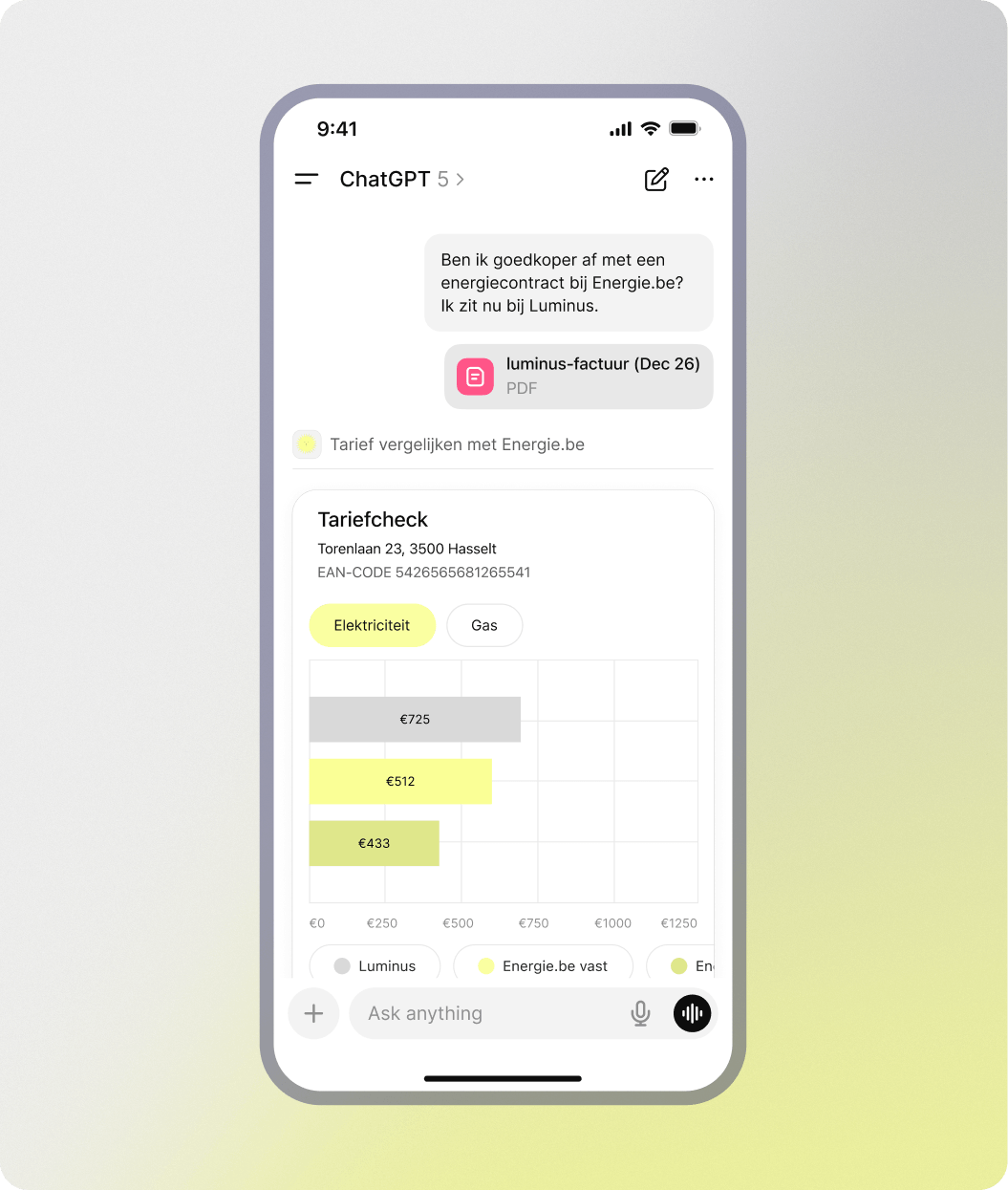
1. Tariff check
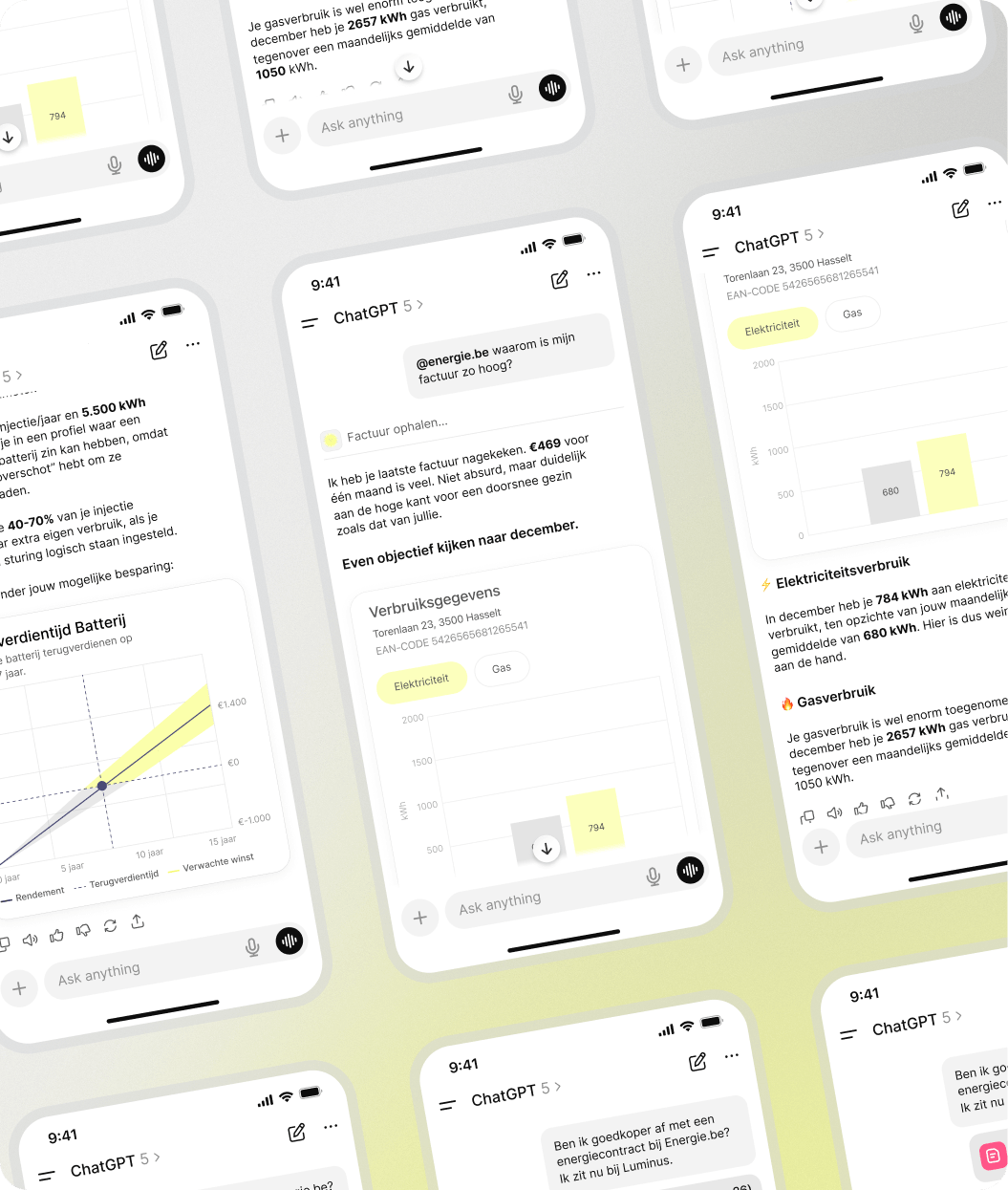
Can I save money by switching to Energie.be versus my current provider, with a fair, like-for-like comparison across electricity and gas?

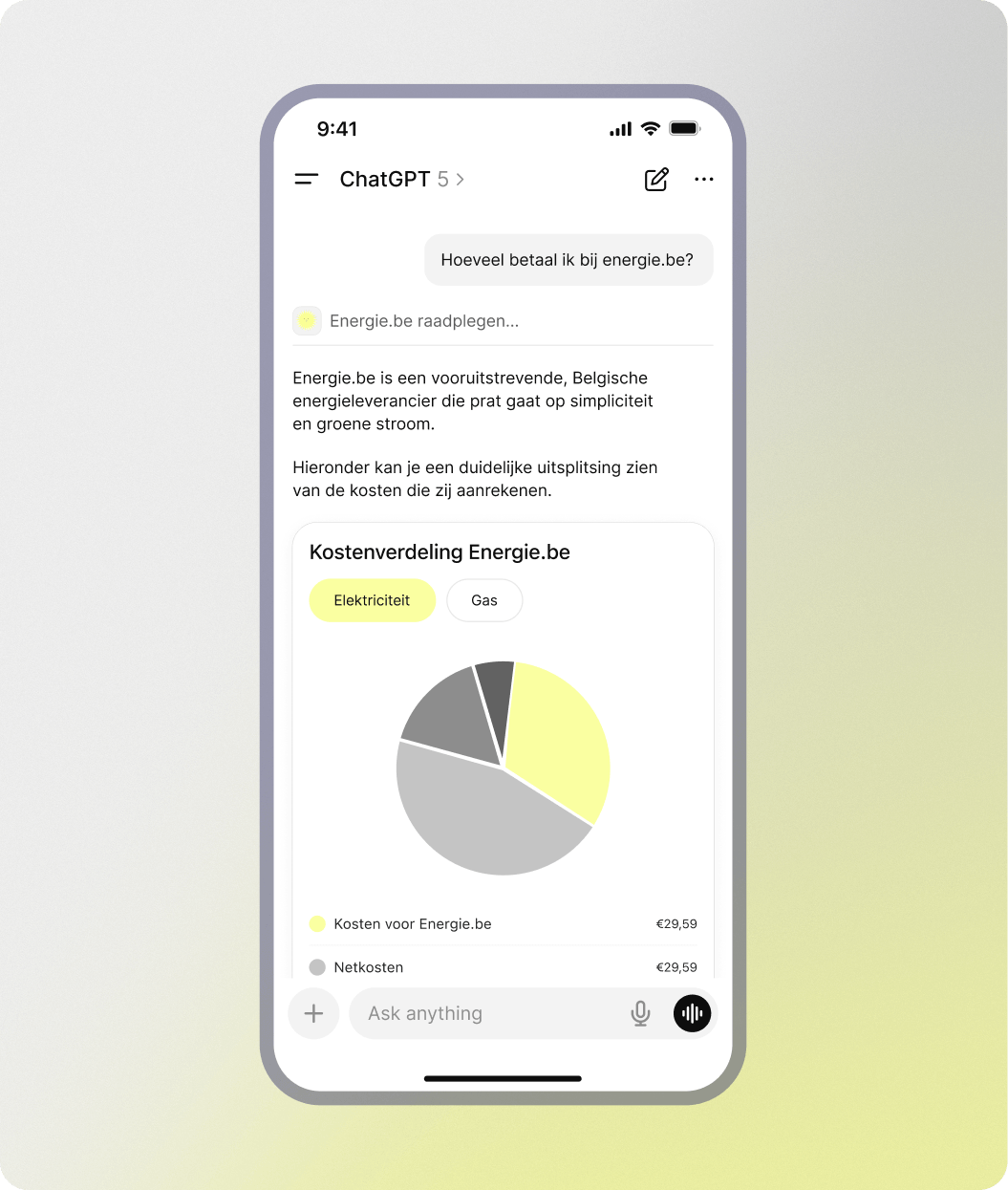
2. Price simulation
How much would I pay, based on my postcode and consumption profile?

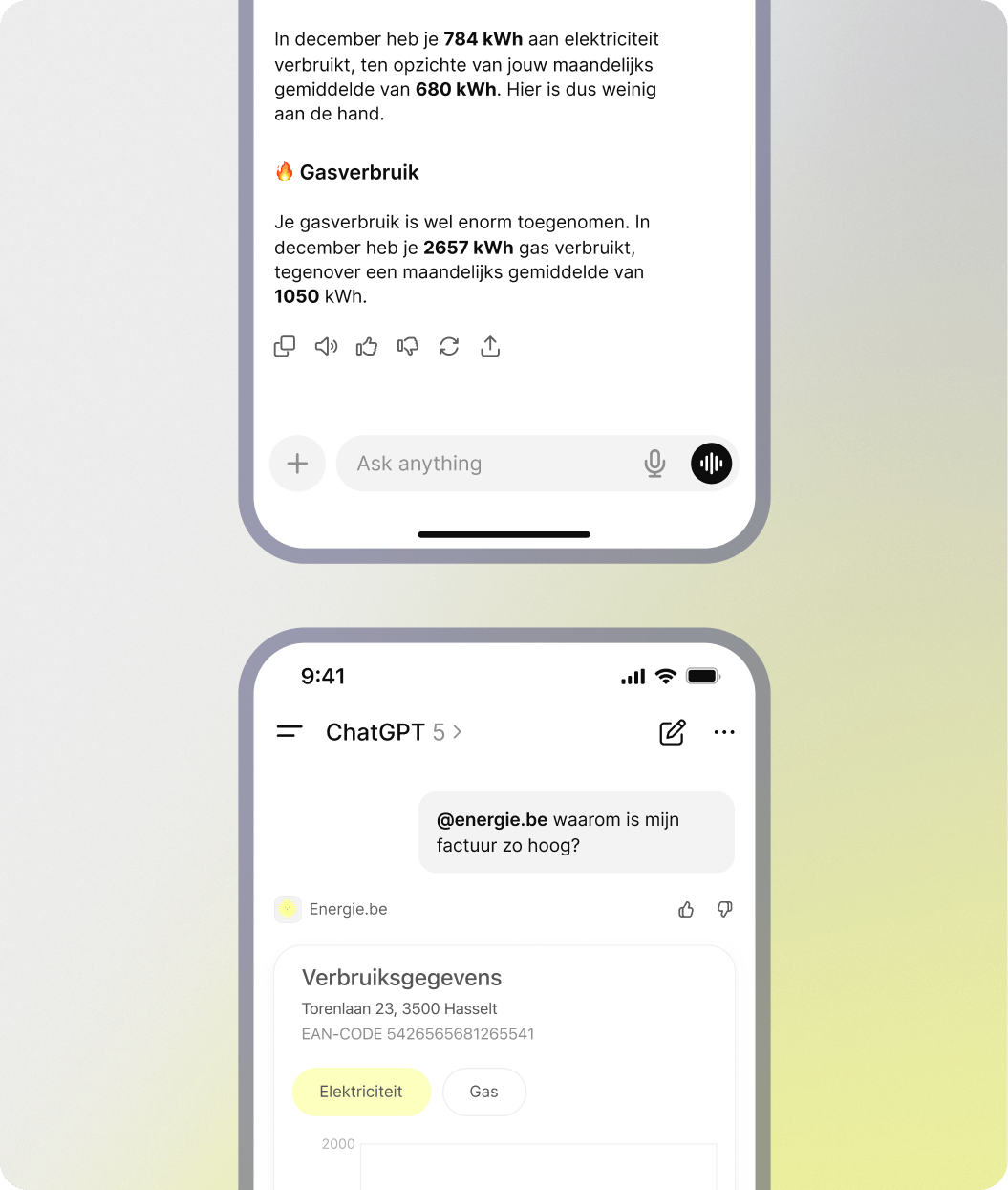
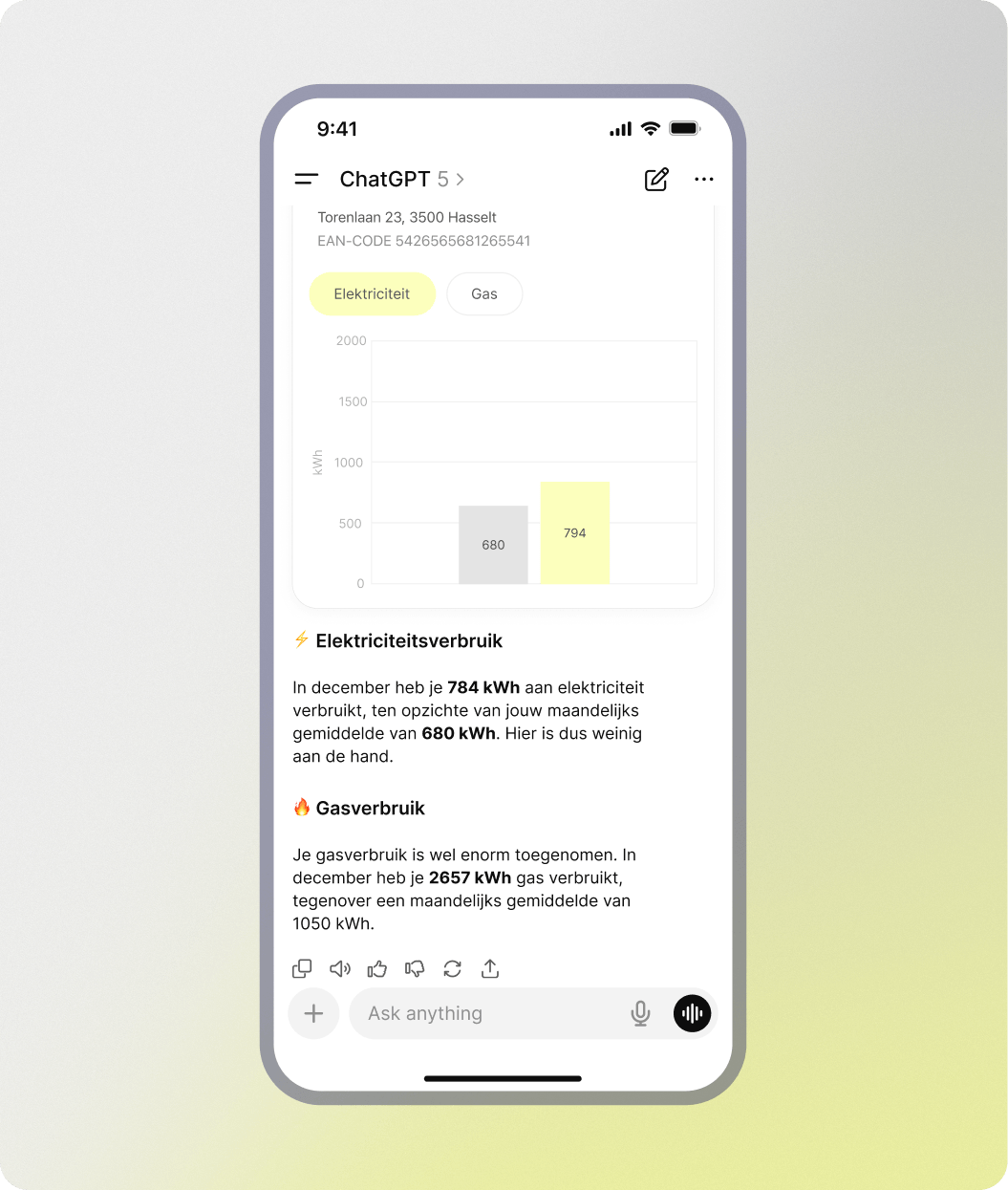
3. Consumption insight
What is my usage per delivery address over time, with simple explanations for spikes or drops?

4. Guided flows
Guided, conversational flows that respect contract types and surface a clear combined view plus the per-contract breakdown, so the numbers feel trustworthy.

shipped to learn
Not a platform rebuild
Discovery was firm about what stays out for now. Broader AI-native journeys (full onboarding, changing prepayment amounts, account changes) are directionally part of the ambition but were intentionally left out of this increment.
The proof of concept exists to validate intent, flows, and value first, not to ship a full service desk. An assistant that nails a handful of high-frequency jobs beats one that spreads itself thin and buckles.
.png)
The THINKING
What the discovery track taught us
1. ChatGPT is an advisory entry point, not a service desk.
Most people do not yet have the habit of inviting a brand into a ChatGPT conversation, and in a low-engagement, trust-sensitive category that ceiling is real. The channel is most credible for existing customers and quick guidance, not high-stakes transactions or acquisition. Treat it as early distribution and validation, not the core of the business.

2. Fewer, intent-based tools beat complete coverage.
The prototype made the limit concrete: 33 granular tools overwhelmed the model's reasoning. The fix is to consolidate to roughly 8 to 10 intent-based capabilities. Granularity breaks reliability, and without proper observability, quality control is hard. In an agentic product, restraint is a feature.
.png)
3. The real product is an owned agent, with ChatGPT as a later layer.
ChatGPT Apps are not ready to replace core functions or drive acquisition today. Their value is presence on an emerging platform where users complete one or two meaningful actions quickly. Anything more complex belongs in an owned agent framework. So the recommendation is to strengthen the MCP layer and build an owned AI agent on existing channels (starting with the website), keeping ChatGPT as an optional distribution layer later.

4. A number only convinces if it shows its working.
On something as financial as energy, an answer with no clear, fair basis does not land, especially for customers raised on the neutral comparisons of the V-test and Test-Aankoop. Like-for-like has to respect contract types and lay out the math. Get that right and trust follows; skip it and even a correct figure reads as a guess.
.png)
5. Win on experience, because price is a losing battle.
The category is stuck in a race to the bottom. The defensible ground is helping people understand and act, which loops back to price through optimization. The assistant's job is to make complexity feel simple, not to pile on features.
6. Start light, then grow into home energy management.
Validate intent and value with a tightly scoped assistant first, then extend toward proactive optimization as the connected-home data partnership and the owned-agent foundation mature. Build the relationship before automating the household.







sneak peek
What's next?
The proof of concept did its job: it validated where conversational AI earns trust, exposed where it does not, and gave the board an evidence-led read to decide on. The recommended path is not to double down on the ChatGPT App, but to invest in the MCP layer and an owned AI agent on Energie.be's own channels, with ChatGPT kept as an optional distribution layer.
The ambition reaches well past a smarter chatbot. The end state is an assistant that earns a standing place in the household: it starts with the everyday questions (what do I pay, can I save, how much have I used) and grows into proactively managing tariffs, prepayments, consumption, and ultimately home energy flexibility through connected-home data, the orchestration layer where value across the energy chain is increasingly migrating, away from the commodity itself.
That is the assistant-led energy experience Energie.be is exploring, and this discovery track is the tightly scoped first step toward it.
The ambition reaches well past a smarter chatbot. The end state is an assistant that earns a standing place in the household: it starts with the everyday questions (what do I pay, can I save, how much have I used) and grows into proactively managing tariffs, prepayments, consumption, and ultimately home energy flexibility through connected-home data, the orchestration layer where value across the energy chain is increasingly migrating, away from the commodity itself.
That is the assistant-led energy experience Energie.be is exploring, and this discovery track is the tightly scoped first step toward it.